When you acquire land anywhere in Nigeria — whether in Lagos, Abuja, Port Harcourt, Ibadan, or Owerri — the very first step every experienced developer advises is simple: fence your boundary immediately.
Fencing your plot secures your legal boundary, prevents land grabbers (popularly known as Omo Onile) from encroaching or reselling, and establishes physical possession before full-scale construction begins.
However, calculating the exact materials needed is where most landowners lose money. If you rely on guesswork or unscrupulous roadside estimates, you risk buying hundreds of surplus blocks that deteriorate in the rain, or running out of materials halfway through the work and paying double for emergency haulage.
Here is the exact, engineering-backed breakdown to calculate how many blocks, cement bags, and sand tippers you need to fence one standard plot of land in Nigeria.
Step 1: Understand Your Plot Perimeter (50×100 ft vs 60×120 ft)
In Nigeria, a "plot" varies depending on the state and survey standard:
-
Standard 50 ft × 100 ft (approx. 15.24m × 30.48m):
- Perimeter = 50 + 100 + 50 + 100 = 300 feet (91.44 meters)
- Rounded engineering perimeter: ~90 meters
-
Standard 60 ft × 120 ft (approx. 18.28m × 36.57m):
- Perimeter = 60 + 120 + 60 + 120 = 360 feet (109.7 meters)
- Rounded engineering perimeter: ~108 meters
Step 2: Calculate Blocks Needed Per Line (Coach)
A standard concrete block in Nigeria measures 450mm (0.45m) in length.
When bricklayers lay blocks, the mortar joint between each block adds roughly 25mm (0.025m). Therefore, the effective length of each laid block is 0.475 meters.
-
For a 50×100 ft plot (90m perimeter):
- 90m ÷ 0.475m = 189.5 blocks per coach (single line)
- Deducting a standard 3.6m (12 ft) gate opening: 3.6m ÷ 0.475m = ~8 blocks
- Net blocks per coach = ~182 blocks
-
For a 60×120 ft plot (108m perimeter):
- 108m ÷ 0.475m = 227.3 blocks per coach
- Deducting the 3.6m gate opening = ~8 blocks
- Net blocks per coach = ~219 blocks
Step 3: Foundation vs Above-Ground Wall Coaches
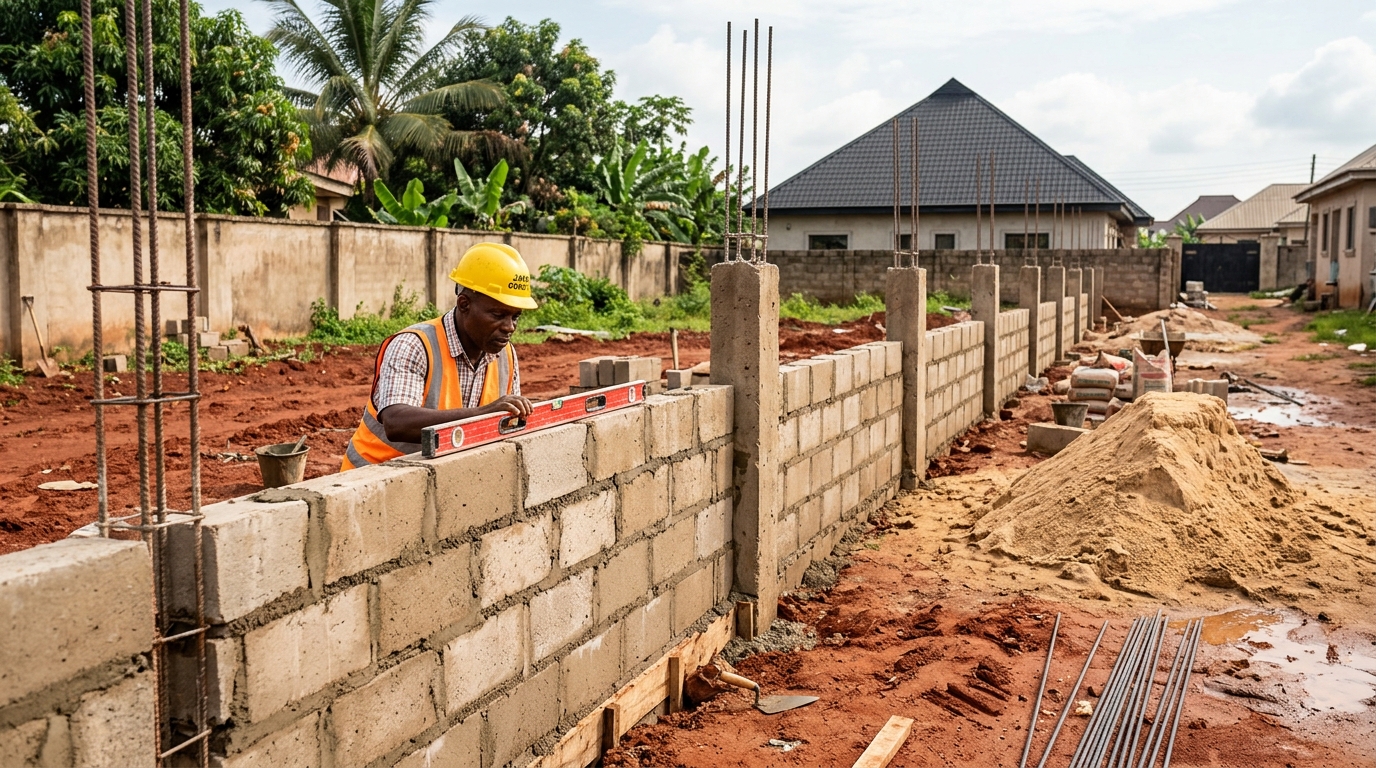
Never build an entire fence with hollow blocks from the trenches up. A durable Nigerian perimeter fence requires two distinct stages:
1. Foundation Footing (Below Ground to DPC)
- You must dig a trench roughly 0.6m (2 feet) deep.
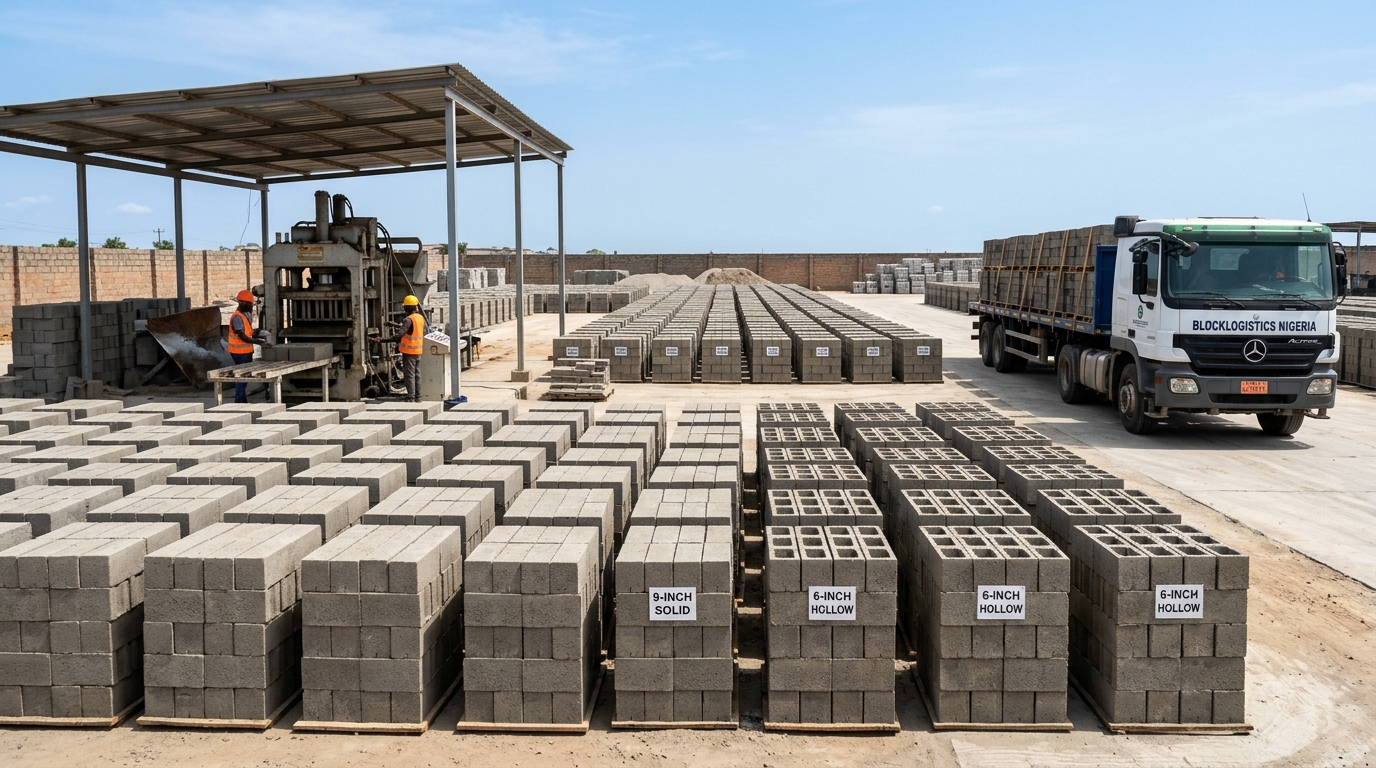
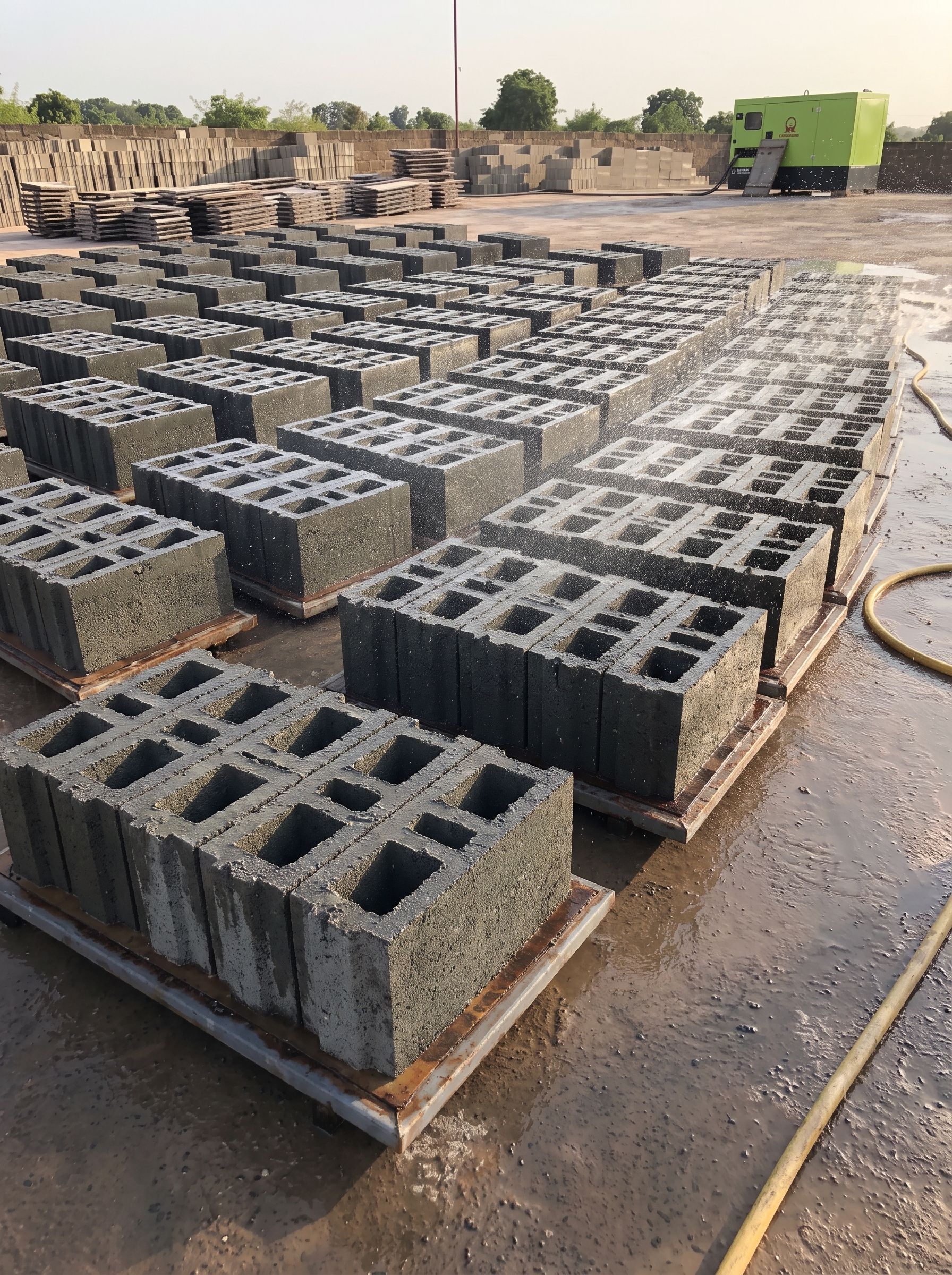
- Lay 2 to 3 coaches of 9" Machine-Vibrated Solid Blocks below ground up to the Damp Proof Course (DPC) level.
- Why solid blocks? Ground moisture, runoff rain, and shifting soil will quickly soak into and crush hollow blocks. Solid concrete blocks resist lateral earth pressure and prevent water seepage.
- Blocks needed for 3 foundation coaches (50×100 ft): 182 × 3 = 546 units of 9" solid blocks.
2. Wall Coaches (Above Ground)
- Standard Residential Fence Height: Typically 7 coaches above DPC (~1.6m or 5.2 feet) for open estates, or 9 coaches (~2.1m or 7 feet) for standard privacy and security.
- Use 6" Heavy Duty Vibrated Blocks for these coaches.
- Blocks needed for 7 above-ground coaches (50×100 ft): 182 × 7 = 1,274 units of 6" blocks.
- Blocks needed for 9 above-ground coaches (50×100 ft): 182 × 9 = 1,638 units of 6" blocks.
Step 4: Account for Structural Reinforcement Pillars
Fences without columns will collapse when strong windstorms hit during the Nigerian rainy season.
- Concrete columns (pillars) should be cast at intervals of every 3 meters (approx. 10 feet or every 6 blocks).
- For a 50×100 ft plot, you will have roughly 28 to 30 pillars.
- Pillars beside the gate must be double-reinforced to withstand the heavy swinging weight of an iron gate.
Step 5: Always Add the 10% Safety Buffer
Never order only the exact theoretical number of blocks. On Nigerian construction sites:
- Delivery trucks offload manually onto sandy or uneven ground, causing 2% to 4% transit chipping.
- Masons must cut blocks to form interlocking corners and fit around concrete pillars.
Adding a 10% wastage allowance ensures your site workers never stall halfway through the day waiting for an expensive top-up delivery.
Total Bill of Quantities Summary (50×100 ft Plot - 8 Coaches Total)
| Material | Quantity Required | Purpose |
|---|---|---|
| 9" Vibrated Solid Blocks | 550 – 600 units | Foundation footing & DPC |
| 6" Vibrated Blocks | 1,400 – 1,500 units | Fence perimeter wall |
| Dangote / BUA 42.5R Cement | 45 – 55 bags | Trench footing concrete & joint mortar |
| Clean Sharp Sand | 1 × 20-tonne Tipper | Mortar mixing & column casting |
| Granite (3/4" Aggregate) | 1 × 10-tonne Tipper | Foundation footing & pillar concrete |
| 12mm Reinforcement Rods | 25 – 30 lengths | Column pillars & lintels |
Pro-Tip: Measure Your Plot Using Your Phone Camera
Instead of climbing muddy trenches with a manual measuring tape, open the Blucindustry In-App Block Calculator.
Using Apple ARKit live camera scanning, you can simply point your iPhone camera along your boundary fence lines. The app automatically detects corners, deducts the standard 25mm mortar joints, adds your 10% safety buffer, and shows your total Naira cost upfront.
You can order verified, machine-vibrated concrete blocks delivered straight to your site with live GPS tracking on Blucindustry App on iOS and Android.