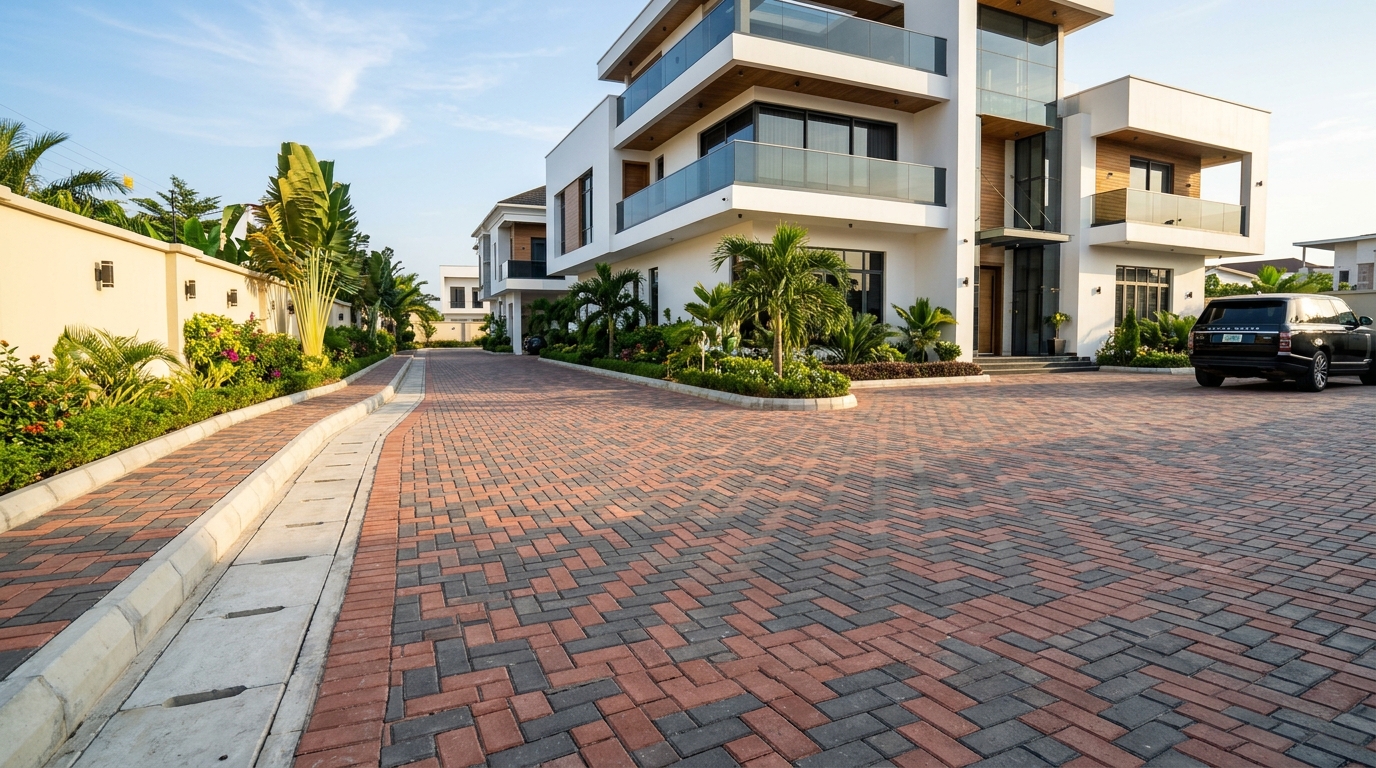
Walk into modern residential estates across Lekki, Ikeja GRA, Maitama Abuja, or Old GRA Port Harcourt, and one design standard stands out: interlocking paving stones.
In Nigerian construction, cast concrete flooring (popularly called "German floor compound") is rapidly being replaced by precast interlocking stones. Why?
- Plain concrete compound floors inevitably develop unsightly cracks under seasonal temperature swings and soil movement.
- Interlocking stones provide built-in joint flexibility, absorb heavy vehicular traffic, allow stormwater drainage between joints, and can be lifted and re-laid cleanly whenever underground plumbing or electrical cables need maintenance.
If you are planning to pave your compound, here is the complete 2026 cost guide, thickness selection, and installation best practices.
Interlocking Stones Cost Per Square Meter in Nigeria
To budget accurately, understand that paving your compound involves four distinct cost components:
| Component | Estimated Cost (2026) | Notes |
|---|---|---|
| Precast Interlocking Stones | ₦4,500 – ₦6,800 per m² | Depends on 60mm vs 80mm thickness & color pigment |
| Bedding Sand / Stone Dust | ₦800 – ₦1,200 per m² | Clean sharp sand or quarry stone dust for leveling bed |
| Road Kerbs (Edge Restraints) | ₦1,800 – ₦2,500 per linear meter | Essential to prevent perimeter stones from sliding |
| Laying & Compactor Labor | ₦800 – ₦1,500 per m² | Professional paver laying + mechanical plate vibrator |
Average Total Installed Cost: Expect between ₦7,500 and ₦10,500 per m² for a fully finished, machine-compacted compound.
60mm vs 80mm Thickness: Which Do You Need?
Choosing the wrong stone thickness is one of the most expensive mistakes on Nigerian properties:
1. 60mm Interlocking Stones (Light to Medium Duty)
- Best for: Residential compounds, private car garages, pedestrian garden walkways, school courtyards, and terraces.
- Weight Rating: Easily supports family SUVs, sedans, and light delivery vans.
- Advantage: More economical while providing high aesthetic appeal.
2. 80mm Interlocking Stones (Heavy Duty Industrial)
- Best for: Commercial plazas, estate entrance boulevards, church auditoriums, factory access yards, and truck logistics depots.
- Weight Rating: Engineered to withstand 30-tonne articulated trucks, diesel fuel tankers, and container haulage tippers without cracking.
- Advantage: Unrivaled compressive strength and zero surface pulverization.
Popular Interlocking Designs in Nigeria
- Double-T Paving Stones: The gold standard in Nigerian real estate. The interlocking neck design locks all adjacent stones on both the X and Y axes, making it virtually impossible for stones to shift or dislodge under sudden vehicle braking.
- Zigzag / Uni-Decor: Classic interlocking pattern with exceptional lateral grip, frequently chosen for access roads and service stations.
- Cobblestone & Rectangular Bricks: Clean, minimalist European look ideal for contemporary luxury duplexes and patio finishes.
The Exact Formula: How Many Stones Make 1 m²?
Under international civil engineering standards (BS EN 1338) followed by Blucindustry: $$ ext{Standard Interlocking Stones} = 36 ext{ pieces per } 1.0 ext{ m}^2$$
Worked Example for a 350 m² Compound:
- Base Stones: $350 imes 36 = 12,600 ext{ pieces}$
- Add 5% cutting wastage around kerbs and corners: $12,600 imes 1.05 = mathbf{13,230 ext{ pieces}}$
- Bedding Sand: Roughly 1 to 2 tippers of clean stone dust.
- Road Kerbs: Measure the total outer perimeter in linear meters (1 kerb per meter).
The 4 Golden Rules: How to Prevent Sinking Compounds
The biggest fear homeowners have with interlocking stones is uneven sinking after one rainy season. Follow these 4 rules to guarantee your driveway stays flat for decades:
- Excavate Organic Topsoil: Never lay sand bed on loose black soil or grass. Strip the topsoil down to solid red laterite ground.
- Compact the Sub-Grade Soil First: Use a mechanical roller or vibrating plate compactor to thoroughly consolidate the sub-base before spreading your bedding sand.
- Install Precast Road Kerbs Along Every Edge: Paving stones act like a compression carpet; without heavy concrete kerbs mortared along the edges, the stones will spread outwards and collapse at the boundaries.
- Joint Sanding and Final Compaction: After laying the pattern, spread dry fine silica sand across the surface and run the plate vibrator over the stones. The vibrating action forces sand deep into the joints, locking the stones into an immovable, monolithic surface.
Order Machine-Vibrated Interlocking Stones Direct
Explore high-density Double-T Interlocking Stones on Blucindustry. With certified 36 pcs/m² coverage and instant shipping mass calculations, you can order directly to your site with verified haulage logistics.